

The Osmosis Protocol: Market Intelligence for GTM Teams
Stop running on proxy data. The Osmosis Protocol is a 4-phase framework for building continuous market intelligence into your CRM and GTM operating model.
Stop running on proxy data. The Osmosis Protocol is a 4-phase framework for building continuous market intelligence into your CRM and GTM operating model.
Two restaurants. Same street. Same foot traffic. One is running a "free fries with every order" promotion to fill tables. The other just put a Dubai Martini on the menu three weeks before every competitor in the city.
OPERATOR INSIGHT |
|---|
One of them read the room. The other one read last quarter's sales report. The difference isn't budget, headcount, or luck — it's the quality of intelligence feeding every decision from menu design to how the host greets a returning guest. Most GTM organizations are running Free Fries logic on Dubai Martini ambitions. This is the protocol that fixes that. |
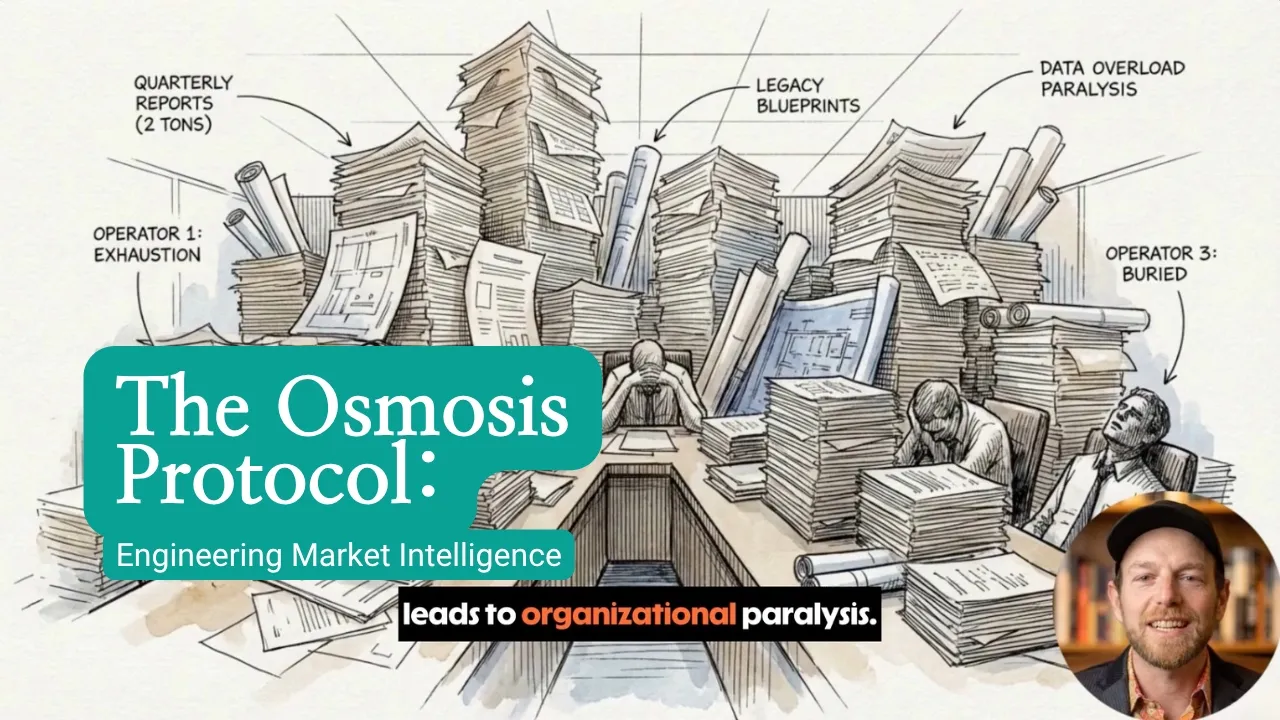
Most revenue teams believe they understand their market. They track hiring signals. They monitor web traffic. They run quarterly win/loss reviews and call it research. What they're actually doing is pressing their face against a frosted window and calling the blur a view.
The signals they're reading — job postings, intent scores, social engagement — are proxy data. They approximate what's happening in a customer's operational reality without ever describing it directly. A Norwegian fish importer posting three logistics coordinator roles isn't signaling growth. They're signaling a constraint. The difference between those two interpretations is the difference between a pitch that opens a door and one that gets filed under "not a fit right now."
Market research is no longer a periodic consultant project. It is a continuous, governed operational muscle — and the organizations that treat it as anything less are already losing margin to the ones that don't.
To be fair: the argument for outsourcing intelligence has always been reasonable. External consultants bring objectivity. Periodic research projects create structured deliverables. The cost of building internal intelligence infrastructure is real, and not every organization has the RevOps bandwidth to sustain it. That's not a bad faith position — it's a legitimate constraint.
But a quarterly research report that arrives after the sales cycle has already closed isn't intelligence. It's archaeology. And the organizations waiting for the next consultant engagement to tell them what their customers are already experiencing are making a leadership choice — not managing a resource constraint.
The Osmosis Protocol is a four-phase framework for building market intelligence as an operational system — not a research project, not a consulting engagement, and not a dashboard nobody checks.
It treats the organization the way Open Systems Theory treats any living system: as a metabolism. A system that ingests external matter — in this case, market data — transforms it into usable energy, and distributes that energy across every function that touches revenue. A system that stops ingesting external input doesn't stay stable. It moves toward entropy. The Free Fries Death Spiral isn't a metaphor for bad strategy. It's what organizational entropy looks like in a GTM context — Sales loses margin chasing the wrong accounts, CX becomes a coupon dispenser absorbing the fallout, and revenue declines not because the market moved but because the organization stopped reading it.
The protocol runs in four phases. Each phase has a defined output. Each output feeds the next. The sequence is load-bearing — you cannot calibrate intelligence variables without the risk map, and you cannot build a messaging matrix without validated variables.
Phase | Focus | Duration | Intelligence Objective |
|---|---|---|---|
1 — Portfolio Cartography | Map customer concentration and segment by strategic value vs. commodity exposure | 90 min | A Segmented Risk Portfolio that shows where the business is exposed and where it's defended |
2 — Intelligence Architecture | Define the external data variables that describe your ICP's operational reality | 60 min | An Intelligence Variable Registry — a governed list of market signals tied to specific customer behaviors |
3 — Market Messaging Matrix | Build shared talk tracks across Sales, Marketing, and CX grounded in market reality | 60 min | A Cross-Departmental Messaging Matrix — language that reflects what customers are actually facing |
4 — Enrichment Engine | Automate the data flow from external intelligence sources into CRM Deal records | 90 min | An Enrichment Implementation Blueprint — the technical spec and prompt library that keeps the system alive |
MISSION |
|---|
Produce a Segmented Risk Portfolio before any intelligence variable is defined. You cannot build a signal architecture for a customer you haven't classified. This phase gives you the map. |
Every kitchen has a menu. The question is whether the menu was designed around what the kitchen does well, what guests actually order, or what the produce distributor happened to deliver this week.
In the Free Fries restaurant, the menu is a historical artifact. It reflects what sold three years ago, what the previous owner was comfortable cooking, and what the discount promotion requires to maintain margin. The host team seats every walk-in the same way. The wait staff pitches the same specials regardless of the table. The kitchen preps the same volume every Tuesday whether it's a game day or a holiday. Nobody has asked — in any formal sense — who is actually coming through the door and why.
In the Dubai Martini restaurant, the menu is a living intelligence document. It reflects what the most valuable guests are ordering in comparable markets before those trends arrive locally. The host team tracks returning guests by preference and spend. That information reaches the test kitchen. The test kitchen designs accordingly. The result looks like luck from the outside. It isn't.
Most GTM organizations have a Free Fries menu. They have a customer list, a pipeline, and a CRO who can tell you the top ten accounts by ARR. What they don't have is a map of what that portfolio actually means in terms of concentration risk, strategic alignment, and ICP accuracy. Portfolio Cartography fixes that. It produces three outputs.
ACTION |
|---|
Segment the portfolio by strategic value. Pull your full customer list into a working view. Classify every account across two dimensions: ARR contribution and ICP fit. ICP fit is not a gut call — it is a scored assessment against the variables that predict retention, expansion, and referral behavior in your best accounts. Accounts that score high on both dimensions are your defended segment. Accounts that score high on ARR but low on ICP fit are your concentration risk. Accounts that score low on both are your commodity exposure — generating revenue, but not generating intelligence about what your best future customers look like. |
ACTION |
|---|
Identify your concentration exposure. Any account representing more than 15% of total ARR is a concentration risk regardless of ICP fit. Any vertical representing more than 40% of total ARR is a portfolio imbalance. Document both. This is not a crisis assessment — it is a baseline. You cannot make intelligent decisions about which markets to pursue, which segments to defend, and which accounts to qualify out of the pipeline without knowing where you are overexposed. |
ACTION |
|---|
Document the Segmented Risk Portfolio. The output of this phase is a written document — not a CRM view, not a spreadsheet, not a slide. A document that states: here is our defended segment, here is our concentration risk, here is our commodity exposure, and here is what our actual ICP looks like when derived from behavioral reality rather than aspirational targeting. This document lives in your CRM as a pinned note on the company record for your top accounts and as a governed property set at the portfolio level. |
OPERATOR INSIGHT |
|---|
The finding that surfaces in almost every Portfolio Cartography exercise is the same: the top 20% of accounts by ARR look almost nothing like the accounts Sales is currently chasing. The ICP on paper — the one in the deck, the one in the onboarding materials — was built from aspirational thinking, not from the actual behavioral and operational profile of the customers who stayed, expanded, and referred. The map doesn't lie. The deck does. |
MISSION |
|---|
Build the Intelligence Variable Registry — the governed list of external market signals that describe your ICP's operational reality. Proxy signals go in the trash. This phase defines what you actually need to know. |
The Free Fries kitchen runs on assumptions. The wait staff reports that table seven seemed unhappy. The kitchen adjusts the seasoning. Nobody asks what table seven ordered last time, what they said on the way out, or whether they've been back since. The feedback loop exists in theory. In practice, it stops at the pass.
Intelligence Architecture is the phase where most intelligence initiatives fail — not because the data doesn't exist, but because teams default to the signals that are easiest to collect rather than the signals that are most descriptive of operational reality.
Hiring signals are easy. Web visit data is easy. Intent scores from third-party platforms are easy. None of them tell you whether a Norwegian fish importer is facing a capacity constraint that makes your logistics software the most urgent purchase they'll make this quarter. BOL records do. Shelf sales velocity does. Category import volume by port does. These are operational signals — they describe what is physically happening in a customer's business, not what their marketing team is clicking on.
ACTION |
|---|
Define the signal set for your ICP. Using the Segmented Risk Portfolio from Phase 1, identify the 4-6 external data variables that most accurately predict the behaviors you care about in your best accounts. Not 40 variables. Not a comprehensive data wish list. Four to six. For a B2B organization selling into food distribution, those variables might be: import volume by category, shelf velocity in key retail channels, commodity price indices for primary SKUs, and port clearance lead times. For a SaaS organization selling into mid-market professional services firms: headcount growth rate by department, technology stack changes in the prior 90 days, and contract renewal cycles derived from public procurement data. The variable set is ICP-specific. There is no universal list. |
RED FLAG |
|---|
If your Intelligence Variable Registry contains more than 8 variables, you don't have a signal architecture — you have a data collection project that will never produce an actionable output. The number of variables is not a measure of rigor. It is a measure of whether your team actually understands what drives decisions in your ICP's business. Cut until it hurts, then cut one more. |
ACTION |
|---|
Map each variable to a CRM property. Every variable in the registry must map to a specific CRM property — either an existing field or one that needs to be created. A signal that cannot be stored, queried, and acted on inside the CRM is a signal that exists only in someone's head. Intelligence that lives in someone's head leaves the building when they do. For HubSpot users: these map to Company properties. For Salesforce users: Account fields. Get the field type right before you start populating it — text fields for qualitative observations, numeric fields for quantitative signals, date fields for timing data. |
ACTION |
|---|
Validate the registry against live accounts. Before Phase 3 begins, pull three accounts from your defended segment and run the variable list against each one. Can you actually find this data? Does it tell you something you didn't already know? Does it change how you would approach the next conversation with that account? If the answer to any of those questions is no, the variable is either wrong or unmeasurable. Remove it and replace it with something that passes all three tests. |
OPERATOR INSIGHT |
|---|
The validation exercise in this phase almost always produces the same uncomfortable finding: the sales team already knows most of this information. It lives in call notes, in Slack threads, in the institutional knowledge of your three longest-tenured reps. It has never been formalized, governed, or made available to the teams that need it. Intelligence Architecture doesn't just define what data to collect. It surfaces the intelligence that was already there — and makes it impossible to lose when someone leaves. |
MISSION |
|---|
Translate the Intelligence Variable Registry into a Cross-Departmental Messaging Matrix — a shared set of talk tracks, objection responses, and proactive alert language that every customer-facing team can use immediately. |
This is where the Dubai Martini restaurant's feedback loop becomes visible.
The host team has been tracking which guests linger over the cocktail menu before ordering. That observation — informal, habitual, never written down — reaches the test kitchen through the general manager's weekly debrief. The test kitchen designs a new section of the menu around it. The wait staff gets a two-minute briefing before the Friday shift. The bar team gets a new pour sequence. Four teams. One intelligence signal. Zero wasted motion.
In the Free Fries restaurant, the same information exists. The host team notices the same guest behavior. It goes nowhere. The wait staff continues pitching the burger special. The test kitchen continues iterating on the fries. The feedback loop is broken not because anyone made a bad decision — but because nobody built the infrastructure to carry the signal from the floor to the kitchen.
Market Messaging Matrix builds that infrastructure for your GTM organization.
ACTION |
|---|
Build the Sales talk track. Using the Intelligence Variable Registry, construct a conversation framework that opens with market reality rather than product capability. The talk track is not a script — it is a set of market-aware entry points. For the Norwegian fish importer scenario: the rep opens with an observation about port clearance lead times in the current import cycle, not with a product demo request. The observation demonstrates that the rep understands the operational constraint driving the purchase decision. The prospect doesn't have to explain their business. They have to decide whether to trust someone who already understands it. Map the talk track to your CRM Deal record as a pinned note — structured, templated, updated when the variable set changes. |
ACTION |
|---|
Build the Marketing asset brief. Marketing's output from this phase is not a campaign — it is a Market Perspective brief. A Gamma-produced document that synthesizes the current state of the market variables most relevant to the ICP and positions the organization as the team that has been tracking them. This brief is not a product brochure. It is an intelligence asset. It gets distributed to prospects in active evaluation and to customers approaching renewal. A coupon says: we need your business. A Market Perspective brief says: we understand your business better than your current vendor does. |
ACTION |
|---|
Build the CX alert framework. CX is the host team. They see the returning guests. They know which accounts are quietly disengaging before the cancellation notice arrives. Give them proactive alert language derived from the Intelligence Variable Registry — language that lets them reach out to a customer before the customer feels the pain. If the variable set includes commodity price indices for a customer's primary SKUs and those indices move adversely, CX has a reason to call before the customer's margin erodes to the point where every vendor relationship is under review. That call is not a check-in. It is a demonstration that the organization is monitoring what matters to the customer's business — not just what matters to the renewal forecast. |
OPERATOR INSIGHT |
|---|
The messaging matrix almost always exposes the same organizational truth: CX has been closest to market reality all along. They hear the objections Sales never reported, the product gaps Marketing never surfaced, and the competitive threats the executive team hasn't seen yet. The matrix doesn't just align messaging — it creates the first formal channel for that intelligence to move upstream. Most organizations build it expecting a sales enablement tool. They end up with a competitive intelligence system. |
MISSION |
|---|
Build the Enrichment Implementation Blueprint — the technical architecture that keeps the Osmosis Protocol running without requiring a manual intelligence cycle every quarter. |
Two kitchens. Same menu. One has a supplier relationship, an inventory system, and a prep schedule that runs automatically every morning before the line team arrives. The other relies on the head chef to remember what needs ordering.
Both kitchens produce good food when the head chef is in the building. Only one of them functions when she isn't.
The Enrichment Engine is the prep schedule. It is the governance layer that keeps the Intelligence Variable Registry populated, the CRM properties current, and the messaging matrix reflecting market reality rather than last quarter's assumptions.
Most organizations skip this phase entirely. They run Phase 1 through Phase 3, produce the outputs, and treat the protocol as complete. Six months later, the Segmented Risk Portfolio is stale, the variable registry hasn't been updated since the initial build, and the messaging matrix is running on intelligence that no longer reflects what's happening in the market. The system has stopped metabolizing. Entropy is already running.
There are two implementation paths depending on your current infrastructure.
Scenario A — Teams with external data infrastructure.
If your organization is already using an external enrichment tool, the Enrichment Engine connects that tool to your CRM via integration. For organizations operating in physical goods markets or tighter TAMs where account-level operational signals matter more than contact-level sequencing, Freckle.io is my preferred stack — it ingests BOL records, shelf sales data, and import volume at the source and connects cleanly to CRM infrastructure. For organizations with larger addressable audiences and cold outreach as a meaningful motion, Clay gives you the enrichment flexibility and sequencing integration that scales with that model. The tool changes. The architecture doesn't.
In both cases, HubSpot Breeze interprets the enriched property set and writes an AI-generated intelligence summary to the Deal record — a plain-language synthesis of what the current variable state means for the account relationship, the renewal risk, and the next best conversation. The operator's job in this scenario is governance: maintain the field mapping, review the Breeze output for accuracy, and update the prompt when the variable set changes.
Scenario B — Teams without external data infrastructure.
Most teams reading this are not running Freckle.io or Clay. They may not need to. What they are almost certainly running — and not fully using — is HubSpot Breeze.
Breeze AI credits are included in most HubSpot tiers. The utilization rate across the HubSpot customer base is low enough that "you're already paying for this" is not a rhetorical point — it is an accurate description of the budget situation at most organizations. The Enrichment Engine for Scenario B is not an integration project. It is a prompt library. Three prompts. Run them against existing CRM data. Update the outputs quarterly or when a material market event occurs.
IMPLEMENTATION |
|---|
Breeze Prompt Library — Scenario B Starting Templates Deal records: "Review the activity timeline and contact properties for this deal. Identify the last meaningful buyer signal, flag any gap longer than 14 days between touches, and summarize the three most important considerations for the next conversation." Account records: "Based on the company properties and contact activity for this account, identify which ICP segment this account maps to, note any recent changes that suggest a shift in risk category, and flag whether the current talk track in the pinned note is still market-accurate." Renewal risk assessment: "Review this account's case history, activity frequency, and last engagement date. Identify the three signals most predictive of renewal risk and recommend the proactive outreach trigger that CX should use before the renewal window opens." These are structural templates — not production-ready prompts. Your operator should adapt them to your specific field names, object structure, and ICP variables before running at scale. The adaptation takes an afternoon, not a project. |
PRO TIP |
|---|
The fastest way to validate a Breeze prompt before deploying it across your full account base is to run it against your three highest-risk renewal accounts first. If the output surfaces something your CX team didn't already know, the prompt is working. If it surfaces only what they already know, the prompt needs more specific field references. Calibrate on the accounts where the stakes are highest — the feedback is sharpest there. |
Govern the update cadence.
The Enrichment Engine is not a one-time build. It requires a quarterly review gate: are the CRM properties still being populated? Are the Breeze outputs still accurate? Has the Intelligence Variable Registry changed in ways that require prompt updates? Assign this gate to a named operator — not a team, a person. Diffuse ownership of the update cadence is how the system stops metabolizing.
OPERATOR INSIGHT |
|---|
The organizations that sustain market intelligence long-term don't have better tools than the ones that don't. They have cleaner handoffs — between the data and the humans who act on it, between the phase that produces the intelligence and the phase that consumes it. The Enrichment Engine is not the most technically complex part of this protocol. It is the most organizationally demanding. Building it takes an afternoon. Maintaining it requires someone who treats it as an operating model, not a project deliverable. That distinction is the whole game. |
Every organization running proxy intelligence eventually arrives at the same destination. Sales starts discounting to close deals that should never have entered the pipeline. Marketing pours budget into campaigns calibrated for an ICP that no longer reflects the organization's best customers. CX absorbs the fallout — managing accounts that were oversold, underserved, and already mentally disengaged before the contract was signed.
The spiral is not caused by bad execution. It is caused by a metabolism that stopped processing external reality. The organization is making decisions in an information vacuum and calling it strategy.
Open Systems Theory describes this with uncomfortable precision: a system that does not continuously exchange matter and energy with its environment does not remain stable. It degrades. The Free Fries restaurant doesn't fail because it made one bad decision. It fails because it built an operating model that insulates itself from the information it needs to make good ones.
The Osmosis Protocol is not a research project. It is not a consulting engagement. It is the governance architecture that keeps the organization's metabolism active — ingesting external signals, transforming them into intelligence, distributing that intelligence to every function that touches revenue, and updating the system when the market moves.
The Dubai Martini didn't appear on that menu by accident. Someone in that test kitchen was reading the room six months before the trend arrived. The question is whether your organization has built the infrastructure to do the same — or whether it's still running last quarter's specials and wondering why the line is getting shorter.
Run the protocol. Map the risk. Define the signals. Calibrate the message. Build the engine. The market is not waiting for your next quarterly review to tell you what's already happening.