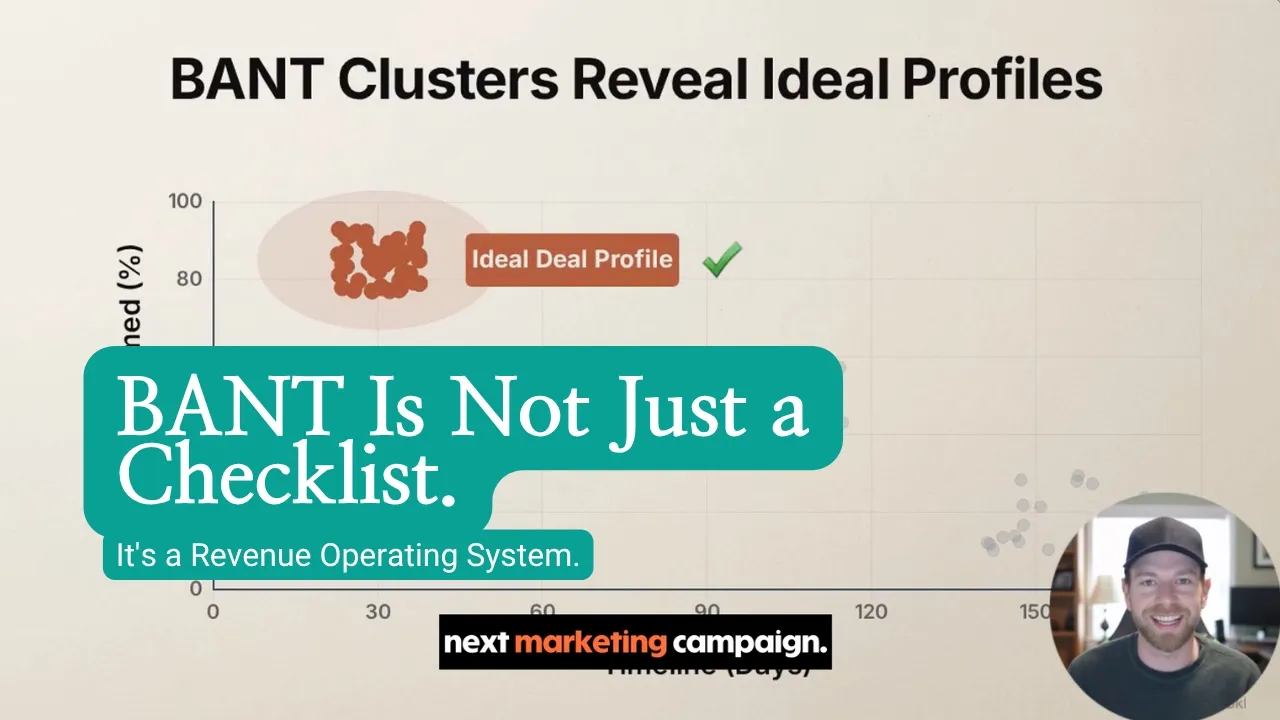
BANT Is Not Just a Checklist. It's a Revenue Operating System.
Every sales team knows BANT. Almost none of them are using it right. Budget, Authority, Need, Timeline were never meant to be a one-time qualifier at the top of the funnel — they're a shared data layer that should travel every deal, every renewal, and every expansion conversation your entire GTM team has.
I've been building GTM systems long enough to remember when BANT was the most progressive thing in a sales org's toolkit. It was clean, it was teachable, and it gave reps a shared vocabulary for what "qualified" actually meant. Those are still its best qualities. The problem isn't BANT. The problem is what we stopped doing with it.
Somewhere along the way, BANT became a checkbox exercise. Reps run through the four letters on a discovery call, log a partial answer in the CRM notes field — where it promptly disappears forever — and move on. The framework that was supposed to create operational clarity became a formality. A ritual without a system.
And to be fair, the skeptics have a point. BANT was designed for a simpler selling environment. Single buyer. Linear pipeline. One handoff from marketing to sales and a clean close. That's not how most deals work anymore. Buying committees are bigger, deal cycles are longer, and the notion that you can qualify a prospect in one discovery call and never revisit those signals is, at this point, a charming fiction.
But that's an argument for expanding BANT — not abandoning it. The vocabulary is sound. The architecture around it is broken.
I've spent a significant part of my career inside natural products — brands selling into retail, through brokers and distributors, across regional and national chains. It's an industry built almost entirely on qualification. A broker won't pick up the phone to a retail buyer without a clear read on all four signals. The stakes of a misread are too high — you don't just lose the sale, you lose the shelf space, the relationship, and the next three opportunities behind it. That discipline is exactly what most B2B GTM teams are missing. And it maps, with uncomfortable precision, onto every pipeline problem I've seen since.
A natural products brand launching a new SKU doesn't present to a retail buyer once and walk away. The qualification conversation starts with a broker, gets refined through a distributor, and doesn't reach the retail buyer until the signal is strong enough to warrant a range review. At every step, the same four data points travel with the product: Is there a confirmed budget for new item placement? Who actually signs off on the ranging decision? Is there a demonstrated consumer need in this geography? And when is the next planogram reset — the window when new items actually get onto the shelf? These aren't discovery questions. They're living data points that update as the deal moves through the system.
Your BANT fields work the same way. The problem isn't that reps don't ask the questions. It's that the answers don't live anywhere a system can read them.
The Structural Fix
BANT needs to exist as four structured properties — not a notes field, not a call summary, not a checkbox in a sales methodology training deck. Four fields, built into every tool your GTM team touches: your CRM, your marketing automation platform, your CS platform, and your executive reporting layer.
In natural products, a broker won't present an unqualified product to a retail buyer. It's not a courtesy — it's a business decision. The broker's relationship with that buyer is the asset. Walking in with a product that has no confirmed buyer need, no ranging window, and no budget discussion on record doesn't just lose the placement. It costs the broker credibility on the next three presentations. So they gate. Before they'll pick up the phone to a buyer, they need samples, pricing, velocity data from comparable accounts, and at least a preliminary read on whether this category has room for a new entry. The qualification has to be strong enough before the next door opens.
That's the model. And it maps directly onto how BANT should gate your pipeline.
Gate
Threshold
What It Unlocks
BANT Fields Required
Gate 1
2 of 4 BANT fields populated
Entry into CRM as a Lead
Any two — but Need or Authority preferred
Gate 2
3 of 4 BANT fields populated
Sales meeting / discovery call booked
Need + Authority + one of Budget or Timeline
Gate 3
4 of 4 BANT fields populated
Active pipeline / proposal stage
All four confirmed — not inferred
Why This Model Works
The gating thresholds do two things simultaneously. First, they create a shared definition of "qualified" that doesn't depend on a manager's judgment call or a rep's optimism. Second, they make the qualification gap visible at every stage. A deal stuck at Gate 1 isn't mysterious — the system tells you exactly which two fields are missing and who owns filling them.
There will be reps who argue that certain deals are "different" — that the buyer is a warm referral, that the timeline is implied, that budget conversations this early damage the relationship. These are real concerns and they deserve acknowledgment.
In natural products, a brand's field sales rep visiting a retail account isn't there just to check that the product is on the shelf. They're there to read two specific signals. First: is there a gap? A competitive product that's been discontinued, a category reset that's left an open slot, a promotional period that's created a temporary need for additional facing. That's the Need signal. Second: when's the next planogram reset? Most grocery chains reset categories on a fixed calendar — quarterly, semi-annually, depending on the category. That reset date is the Timeline signal. A field rep who shows up two weeks before a planogram reset with documented evidence of a gap in the category isn't making a sales call. They're closing an expansion. The intelligence created the urgency.
CS teams in B2B environments have the exact same opportunity. The Need changes as the customer's business evolves. The Timeline resets with every renewal cycle, every new fiscal year, every strategic initiative the customer announces. These aren't renewal conversations — they're qualification events. And they should be documented as BANT updates in the CRM the same way a field rep logs a category gap.
The gap between CS and Sales on expansion isn't a relationship problem — it's a data problem. CS has the updated BANT signals. Sales doesn't know they exist. The fix is structural, not cultural.
A natural products brand that loses a retail placement doesn't just log it as a loss and move on — not if they're operating well. They do a post-mortem. Was the product delisted because velocity was too low? That's a Need failure — the consumer need wasn't strong enough in that geography to sustain the placement. Was it delisted because a competitor came in with a better trade deal during the reset window? That's a Timeline failure — the brand wasn't positioned to defend the placement at the critical moment. Was it never placed at all because the buyer didn't have budget for new items that quarter? Budget failure. Was the range review presented to the category manager when the actual decision maker was the VP of Merchandising? Authority failure. Every lost placement is a BANT autopsy. The brands that do them consistently get better. The ones that don't repeat the same mistakes with better packaging.
Same goes for your pipeline. The losses aren't just losses — they're a diagnostic readout of where your qualification system is failing.
The Three Audit Segments
Build three standing reports in your CRM that segment your BANT failure modes. Run them monthly. Review them in the team meeting, not just the manager's dashboard.
The most sophisticated natural products companies don't just track sales by account — they track which qualification signals preceded their best placements. They know that when a new SKU gets placed in a chain that's underserved in the category (Need), with a buyer who has direct ranging authority (Authority), in the quarter before a major seasonal reset (Timeline), with dedicated new-item placement funds available (Budget), the sell-through numbers are materially better than placements that cleared fewer signals. That pattern is strategy. It tells the brand where to focus their broker resources, which retailers to prioritize in the next launch cycle, and how to sequence the regional rollout to maximize velocity. The qualification data isn't just an operational input — it's a competitive intelligence asset.
Your Closed/Won BANT data is the same asset. Most sales leaders never look at it that way.
The Two Executive Views That Matter
Build two summary dashboards for leadership — one on Closed/Won, one on Closed/Lost — that surface BANT field distributions rather than just deal counts and revenue figures.
Five movements, one operating system. The implementation order matters — you can't gate what you haven't structured, and you can't audit what you haven't gated. Start at Movement I and build forward.
01 — Build the Fields First Four structured BANT properties in your CRM, before anything else. Everything downstream depends on this.
02 — Enforce One Gate Start with Gate 1 — two fields to enter the CRM. One gate, enforced consistently, changes the entire culture of qualification.
03 — Brief Your CS Team Need and Timeline updates from CS are your fastest path to an intelligent expansion pipeline. Don't wait for the full rollout.
04 — Run the First Audit Pull your last 90 days of Closed/Lost records and map them against the BANT fields you now have. The pattern will be immediate.
05 — Show Leadership the Data Thirty days of clean BANT data is enough to build the first executive view. Show them why — not just what — before the next QBR.
The teams that use BANT as a checklist will continue to have the same forecast conversations, the same pipeline reviews, and the same post-mortems that don't change anything. We've been in those rooms. We know how they end.
The teams that build BANT as a system — structured, gated, shared across every customer-facing function, and surfaced at the executive level — will have a different kind of problem. They'll know exactly where the leaks are, exactly which function owns fixing them, and exactly which qualification patterns are driving their best revenue. That's not a small upgrade. That's a different operating model.
Build the fields. Run the gates. Brief the CS team. Read the losses. Show leadership the signal.
We can do this. The vocabulary was always right. Now let's build the system around it.