

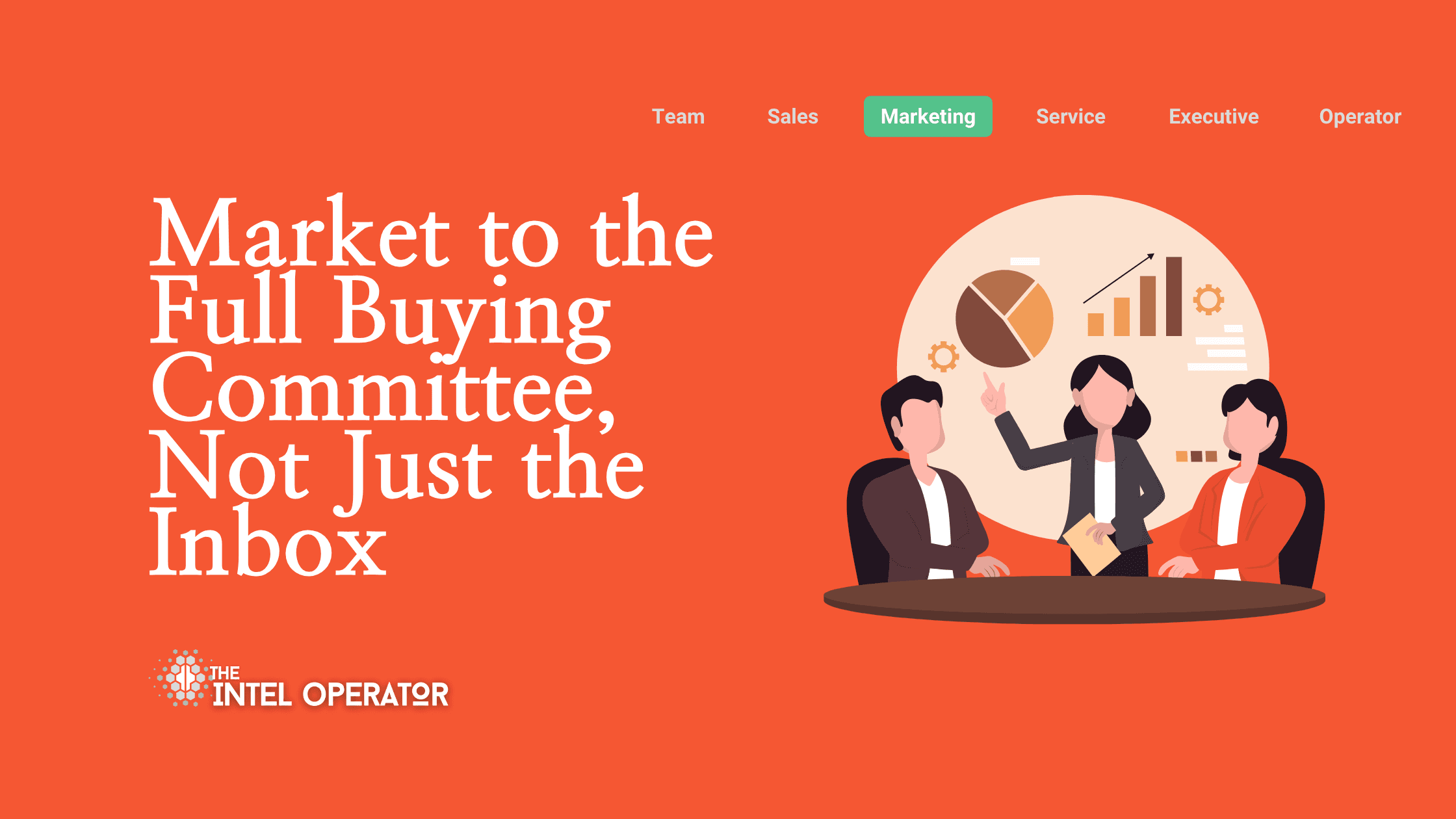
Market to the Full Buying Committee, Not Just the Inbox
Your nurture sequences are reaching the gatekeeper. Here's how to build contact architecture that gets your content to the evaluators who actually decide.
Your nurture sequences are reaching the gatekeeper. Here's how to build contact architecture that gets your content to the evaluators who actually decide.
Your last campaign generated 47 MQLs. Sales worked twelve of them. The other thirty-five sat in sequences built for a procurement contact — while the formulator who actually specs ingredients, the lab tech who kills deals quietly, and the brand manager who controls launch timing never received a single touch. Not because you didn't have their emails. Because nobody built the infrastructure to know they existed.
That's not a campaign problem. That's a contact architecture problem dressed up as a demand generation problem.
To be fair: multi-stakeholder contact mapping is a sales motion, not a marketing function — and asking Marketing to govern buying committee data on top of attribution, MQL definitions, and campaign performance is a real ask. That objection is legitimate. But running campaigns against a partial contact record isn't just inefficient. It's actively misleading. Every conversion rate, every engagement score, every lead score that's been calculated without the full buying committee in the denominator is a number you can't fully defend. The marketers who stay credible in the room are the ones who own the data layer their reporting depends on — not just the campaigns sitting on top of it.
Here's where to start.
Section | What You're Auditing | What It Fixes |
|---|---|---|
1 — Contact Architecture | Who's in your CRM vs. who's in the buying committee | Campaigns reaching the evaluators, not just the inbox-keepers |
2 — Buying Role Segmentation | Whether your contacts have governed roles assigned | Nurture sequences that match what each person actually needs to hear |
3 — Lead Source Governance | Whether your contact capture moments are tagged and trackable | Attribution that reflects the full committee, not just the first form fill |
4 — Intent Signal Routing | Whether evaluator-stage signals are reaching Sales in time | Handoff quality that gives reps a reason to act before the evaluation closes |
The formulation lab runs a strict intake process. A new botanical ingredient doesn't get evaluated because a procurement contact forwarded a spec sheet. It gets evaluated because the right person — the formulator, the lab technician — had the right documentation in front of them at the right moment. Send the spec sheet to the wrong person and it sits in an inbox. Route it correctly and it's on the bench by Thursday.
Your nurture sequences work the same way. The procurement contact who manages your relationship is real and important — but they're rarely the person who evaluates your ingredient's technical performance, validates your label claims, or makes the case internally for switching from a current supplier. Those people are in the buying committee. Most of them are not in your CRM. And the ones that are rarely have a role assigned that would tell your automation which sequence they belong in.
What to Audit | How to Check It | What the Gap Tells You |
|---|---|---|
Count unique contacts associated per Deal/Opportunity in active pipeline | Filter Deals by associated Contact count in HubSpot | Deals with 1–2 contacts are being nurtured through a single relationship — everyone else is dark |
Check how many contacts in your database have a Buying Role field populated | Run a Contact property report filtered by Buying Role completion | Blank Buying Role = no segmentation possible = everyone gets the same sequence |
Identify which buying roles are absent from your Contact records entirely | Cross-reference expected roles against what's actually in the CRM | The missing roles are the audience segments your campaigns have never reached |
Pull engagement data by contact — who's opening, clicking, converting | Segment engagement by job title or Buying Role if populated | High-engagement contacts with no role assigned are invisible to your segmentation logic |
The campaign that converts isn't always the one with the best copy. It's the one that reached the right person at the right moment in the evaluation. You can't engineer that without knowing who the evaluators are.
A formulator evaluating a botanical ingredient needs efficacy data, certificate of analysis benchmarks, and dissolution performance. The marketing lead at the same brand needs consumer trend data, label claim support, and launch timeline confidence. The procurement junior needs documentation templates, compliance resources, and supplier approval process clarity. These are not variations of the same message. They are three different campaigns to three different people with three different definitions of "this vendor is worth moving forward with."
Most marketing teams send one sequence to "the contact." The contact is whoever filled out the form — which is usually the procurement lead, sometimes the brand manager, almost never the formulator or the lab tech. So the formulator never gets the efficacy data. The lab tech never gets the technical documentation tips. The procurement junior never gets the compliance resource that would have made their vetting process faster. And Marketing wonders why engagement rates are flat on a sequence that's technically well-written.
The fix isn't a new sequence. It's a governed segmentation field that your existing sequences can route against.
Buying Role | What They Need From Marketing | Content Type |
|---|---|---|
Formulator | Technical efficacy data, spec sheet benchmarks, formulation compatibility guidance | Technical brief, CoA walkthrough, application notes |
Lab Technician | Evaluation tips, documentation standards, common discrepancy flags | Process guide, pre-evaluation checklist |
Procurement Junior | Supplier approval documentation, compliance templates, vetting criteria | Documentation kit, compliance reference |
Marketing/Brand Lead | Consumer trend data, label claim support, launch case studies | Trend report, campaign toolkit, brand case study |
Economic Buyer (CEO/Finance) | ROI framing, supplier reliability data, switching cost analysis | Business case summary, supplier scorecard |
PRO TIP |
|---|
You don't need five separate nurture tracks to start. Build one role-specific asset for the buying role most absent from your current contact records — for most botanical ingredient marketers, that's the Formulator or Lab Technician. One targeted piece of content is enough to start tagging, tracking engagement, and building the segmentation logic for the rest. |
Role-specific content doesn't require a full campaign rebuild. It requires a governed field and one asset per role that your existing automation can route.
The counterintuitive move here: don't start with your campaign reports. Start with your CRM contact records. The attribution problem most marketing teams diagnose by looking at channel performance data is actually a contact capture problem — and no amount of UTM governance fixes an attribution model built on a partial committee.
In a botanical ingredient deal, the lab technician who evaluated the sample and the formulator who validated the spec are both part of the decision. If neither is in your CRM with a Lead Source field populated, your attribution model has no way to account for the content they engaged with, the email sequence that reached them, or the trade publication where they first encountered your brand. The conversion gets credited to the procurement contact's last touch — which is almost never the actual decision driver.
What to Audit | Where to Check | What It Surfaces |
|---|---|---|
Lead Source field completion rate across all Contacts | HubSpot Contact property report — filter for blank Lead Source | If completion is below 85%, your attribution model is running on a partial dataset |
Lead Source values for contacts added via Sales (not form fill) | Filter Contacts by Create Source = Sales rep or manual entry | Sales-added contacts often have no Lead Source — these are attribution blind spots |
Buying-role-specific engagement by campaign | Segment campaign engagement report by Buying Role property | Which roles are engaging with which content — and which roles have never been touched |
Contact creation source by buying role | Cross-reference Contact create source with Buying Role | If Lab Technicians are only ever added manually by Sales, Marketing has never reached this segment |
RED FLAG |
|---|
If your Lead Source field completion rate is below 85% on contacts associated to closed-won deals, you're not running an attribution model — you're running a best-guess narrative. The contacts who influenced the decision and never got a Lead Source value are the ones that would change your channel story if they were counted. |
Attribution doesn't get fixed by adding more tracking parameters to your campaigns. It gets fixed by ensuring every person in the buying committee has a contact record with a populated Lead Source field — including the ones Sales added manually after the form fill.
A botanical ingredient sample arrives at the lab bench. The lab technician has a documentation question — a small one, the kind that gets resolved in four minutes over email. Nobody at the brand thinks to connect the technician with the supplier rep because that relationship doesn't exist in the CRM. So the question sits. The evaluation stalls. A competing ingredient that already has a relationship with the lab clears the queue first.
That's not a Sales failure. That's a signal routing failure — and Marketing owns the infrastructure that could have prevented it.
When a lab technician or formulator engages with technical content — downloads a CoA, opens an application note, visits a spec comparison page — that's an intent signal from the evaluator node. The team that routes that signal to Sales within the response window gives the rep a reason to reach out that doesn't require going through the procurement contact. The team that doesn't route it watches the evaluation close without ever knowing it was in play.
Signal Type | What It Indicates | How to Route It |
|---|---|---|
Lab Technician opens technical documentation | Active evaluation in progress | Immediate Sales alert — rep should offer to answer technical questions directly |
Formulator downloads application notes or CoA | Spec validation underway | Sales alert with content context — rep follows up with formulation support offer |
Procurement Junior downloads compliance template | Supplier vetting initiated | Enroll in documentation support sequence — reduce friction in the approval process |
Multiple committee members engage within 48 hours | Deal is in active committee discussion | High-priority Sales alert — deal is being evaluated now, not in a future cycle |
The fastest conversion lift in your pipeline isn't a new campaign. It's a workflow that tells Sales when the evaluator is active — before the evaluation closes without them.
The marketing teams that win complex B2B deals consistently aren't running better campaigns. They're running campaigns against a more complete contact architecture — and they build that architecture one buying role at a time, one month at a time, until the segmentation is clean enough to actually tell them something.
Month | Focus | One Campaign to Tighten |
|---|---|---|
Month 1 | Audit contact architecture — count buying roles present vs. absent across active pipeline deals | Identify the single most absent buying role in your CRM and build one asset specifically for them |
Month 2 | Govern the Buying Role field — ensure every Contact associated to an active Deal has a role assigned | Update your form follow-up sequence to include a role-qualification question for Sales-added contacts |
Month 3 | Fix Lead Source completion — audit blank Lead Source values on all Contacts added in the last 90 days | Establish a rule: any contact added manually by Sales requires Lead Source populated before the Deal advances |
Month 4 | Build evaluator signal routing — set up intent alerts for Lab Technician and Formulator engagement | Route one role-specific signal to Sales this month. Measure response time and conversion rate against baseline. |
The campaign that wins the botanical ingredient deal isn't always the one with the best creative. It's the one that reached the formulator with the right technical content before the evaluation closed — and routed the signal to Sales fast enough for them to answer the question that was never asked out loud.
Build the architecture first. The campaigns get better automatically.
The full Marketing-specific buying committee audit checklist — including Lead Source governance criteria, buying role segmentation templates, and evaluator signal routing workflows — is available to The Intel Operator™ subscribers. Subscribe at theinteloperator.com/subscribe.